
To AST191 and 192 Students: The observatory will be ____on Monday, Aug. 31
Weather permitting, observing sessions will be on Monday-Tuesday-Wednesday between Aug. 31 and Oct. 21 during the fall 2026 semester and between March 1 and April 28 for spring 2027. Thirty-minute observing sessions will begin at 9 p.m., 9:30 p.m., 10 p.m. and 10:30 p.m. and will close at 11 p.m. Access is on a first-come, first-serve basis. Do not wait until the last minute; you may not be able to get in. We will announce weather closings at this site and our social media accounts.
Cell phones: Please turn them off while in the observatory. They are a distraction, and the bright screens destroy your ability to see faint objects. Remember to turn them back on afterward.
Notifications: The observatory is closed on nights that are cloudy or predicted to be cloudy. The website, Facebook, and X accounts are updated one hour before the first session, i.e. about 8 p.m. We do our best to be open if the weather permits viewing, but if it unexpectedly clouds up, the observatory will close. We rely on several web sites for predicting cloud cover, including Attilla Danko's Clear Sky Chart for Lexington, KY and the National Weather Service cloud cover prediction. The MacAdam Student Observatory is located on the upper deck of Parking Structure No. 2 at 301 Hilltop Ave, adjacent to the William T. Young Library and the Jacobs Science Building. The upper deck lights may be off; please park below the upper deck level as students will be present. The Off-Peak parking map can be found here:
- Is it going to be clear or cloudy tonight? See Attilla Danko's page for your area. In Lexington, we use this: Clear Sky Chart. Read the top line of the chart: White is cloudy, and dark blue predicts clear skies.
- Astronomy Picture of the Day: A visually stunning page with a cogent paragraph explaining the daily image. The archives go back to June 1995.
- SpaceWeather: Updated every day, the site covers the sun, the solar wind, aurora borealis, noctilucent clouds and information of bright satellite passes over your location. (See Satellite Flybys in the panel on the right.)
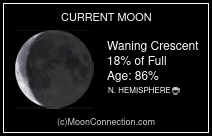
|
